A magnetic separator quotation can range from roughly ₹1.5 lakh to more than ₹15 lakh because a pulley, drum, suspended magnet, and self-cleaning overband unit solve different separation problems. By comparing the design, feed conditions, included equipment, safety provisions, installation scope, and lifetime operating cost, you can judge whether a quoted price suits your appliance or electronics scrap line.
Key takeaways
- Budget ₹1.5–6 lakh before GST, freight and installation for smaller separators.
- Choose pulley, drum or overband designs based on material flow and ferrous content.
- Give suppliers feed size, throughput, moisture and material details for comparable quotes.
- Compare power, maintenance, recovery and installation costs—not only the purchase price.
What magnetic separator price in Ghaziabad should you budget?
A realistic magnetic separator price in Ghaziabad is about ₹1.5–6 lakh for a permanent-magnet pulley or small drum separator, before GST, freight and site installation. Larger drums, custom housings and high-throughput machines can exceed this range.
| Separator configuration | Indicative equipment budget | Why the quotation changes |
|---|---|---|
| Permanent pulley or small drum | ₹1.5–6 lakh | Diameter, belt width, magnet construction and frame |
| Suspended over-belt magnet | ₹4–15 lakh | Self-cleaning belt, working gap, supports and controls |
| Large custom drum or over-belt system | Above ₹6–15 lakh | Throughput, wide conveyors, stronger construction and integration |
Two quotations differ widely because they may not describe equivalent machines. Check whether each price includes the conveyor, steel frame, motor and drive, control panel, guarding, emergency stop, installation, commissioning, GST and freight.
Ask for these fields in writing:
- Belt width, separator width, conveyor length and feed opening
- Magnet type or grade, magnetic strength at the actual separation gap, and drum or pulley diameter
- Rated feed rate in kg/h, belt speed, electrical load and maximum burden depth
- Structural supports, safety guarding, spare parts, warranty exclusions and delivery basis
Do not compare surface field strength alone. A magnet reading at the housing can look impressive while separation fails on deep, damp material or steel enclosed in plastic. Request a trial with representative appliance and electronics scrap, including motors, compressors, tangled wires and laminated sheet, before treating either quote as equivalent.
Which separator design fits appliance and electronics scrap?
Choose by how the scrap is presented, not by magnet name alone. A magnetic separator for appliance recycling belongs after depollution and rough size reduction, where it can remove ferrous steel before an eddy-current separator or optical sorter. A thin, even burden gives better recovery than an overloaded belt.
| Option | Best position | Strength | Main limitation |
|---|---|---|---|
| Permanent over-belt magnet | Above a conveyor after shredding or dismantling | Lifts ferrous pieces from a deeper appliance-scrap burden | Needs support steel and a correctly sized magnet-to-belt gap |
| Magnetic head pulley | At the conveyor discharge, replacing the head pulley | Compact and lower-cost; separates steel as material leaves the belt | Performs poorly with a deep, fast-moving burden or weakly attracted pieces |
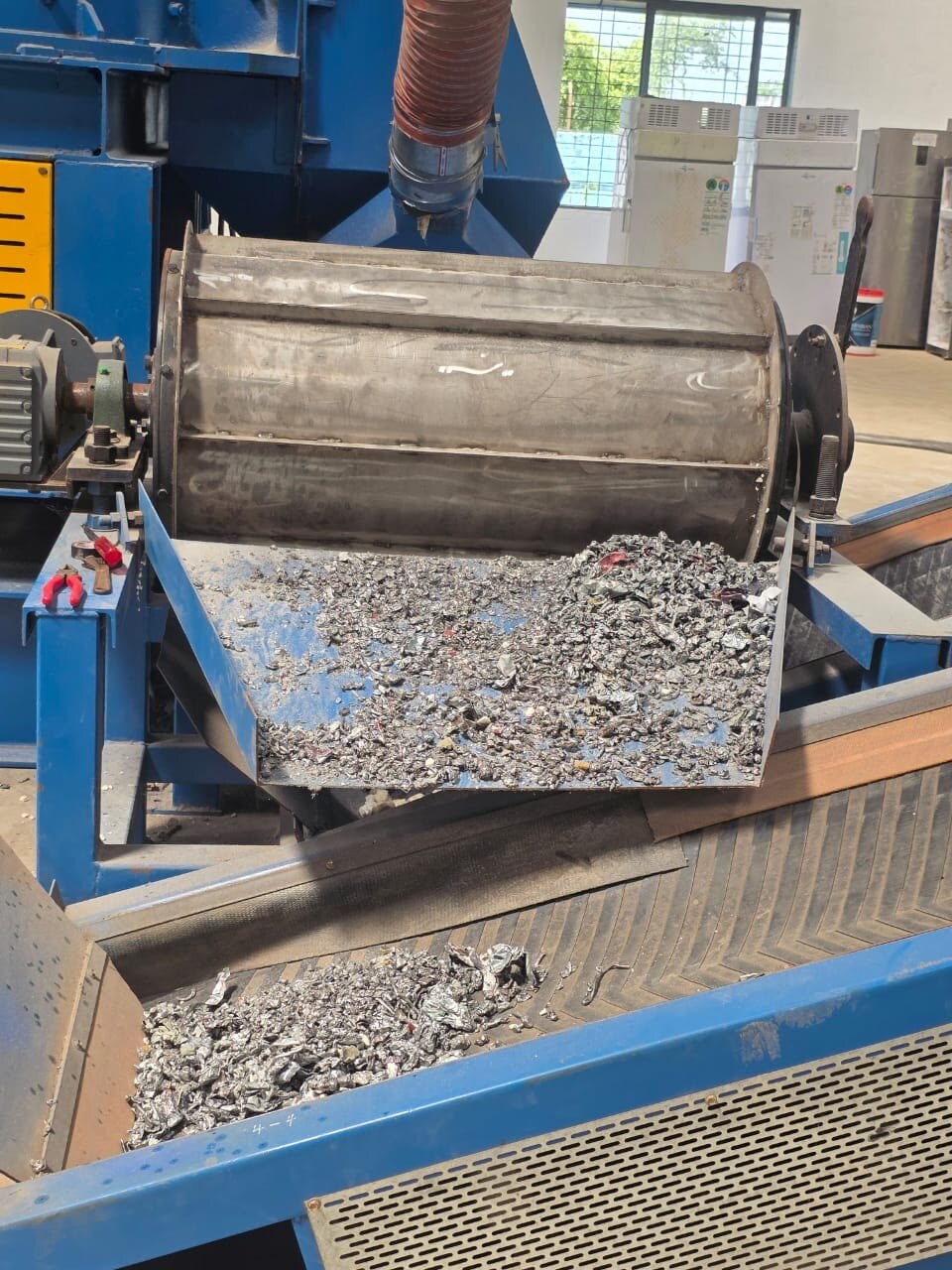
| Magnetic drum | Beneath or at the end of a controlled chute or vibratory feeder | Gives consistent presentation for shredded steel, fines, and PCB fractions | Requires a feeder or enclosure and can choke on bulky appliances |
| Suspended self-cleaning separator | Above a continuous conveyor before downstream sorting | Removes ferrous metal continuously without stopping for manual cleaning | Adds a secondary belt, motor, bearings, guards, and maintenance cost |
Use a head pulley for clean, shallow, low-volume feed. Choose a suspended self-cleaning unit when motors, compressors, laminated sheet, and tangled wires create frequent ferrous carryover during continuous operation. A drum suits controlled shredded fractions; it is not a substitute for lifting whole appliances from a conveyor.
Require a sample trial with the actual mix. Ask for rated tonnes per hour, maximum burden depth, belt speed, gap, and ferrous-recovery result—not a demonstration using loose steel nuts. The right magnetic sorting machine for scrap is the one that meets those figures at your real feed point.
How do you match the separator to your actual scrap feed?
Rate the separator against the heaviest feed hour, not the average. A machine rated at 2 tonnes per hour can underperform when a deep, dense burden hides steel from the magnetic field. Require field strength at the actual separation gap, not only the magnet-surface figure.
Record these feed conditions before comparing quotations:
- Feed rate in kg/h or tonnes/h, including peak surges.
- Particle-size range after shredding and screening.
- Bulk density in kg/m³; loose plastics and compact steel behave differently.
- Moisture content, because wet fines cling together and carry ferrous pieces past the magnet.
- Maximum layer depth on the belt.
- Belt speed in metres per second and magnet-to-belt distance.
- Ferrous content as a percentage by mass, plus the target recovery rate.
| Feed | Matching point | Risk if mismatched |
|---|---|---|
| Refrigerators, washing machines, air conditioners | Shred or screen before separation; expose motors, compressors and sheet steel | Steel remains trapped inside plastic or assemblies |
| Mixed appliances | Test variable density, size and ferrous loading | Overloading causes missed recovery |
| Televisions | Use a controlled thin layer after size reduction | Light plastics and glass bury small steel parts |
| PCBs | Test fine, liberated fractions separately | Copper-rich material is not magnetic |
| Wires and fines | Check tangled bundles, moisture and dust carryover | Ferrous pieces pass through or cling to nonmagnetic material |
Use representative scrap for a trial, not loose steel nuts. A magnetic separator for appliance recycling removes ferrous metal; aluminium, copper and nonmagnetic stainless steel need downstream equipment.
What must a Ghaziabad supplier include in the quotation?
A serious quotation must describe the machine you will receive, the conditions under which it will perform, and every cost required to put it into operation. Do not compare a headline price from one magnetic separator supplier in Ghaziabad with an installed price from another.
| Area | Demand in the quotation | Why it matters |
|---|---|---|
| Technical | Magnet type, grade or construction, field strength at the actual separation gap, belt width, effective separator width, drum or pulley diameter, feed opening, frame height, conveyor length, belt speed, and motor power | Surface field strength alone does not prove removal through a deep scrap layer |
| Feed and performance | Rated tonnes per hour for your scrap, maximum burden depth, particle-size range, moisture limit, ferrous content, expected recovery, and the test method | A loose-nut demonstration says nothing about motors, compressors, coated steel, or tangled wires |
| Commercial | Itemised machine price, GST, freight to Ghaziabad, packing, payment schedule, delivery basis, taxes, and price-validity period | Missing freight or GST can erase an apparent saving |
| Installation | Foundation or support drawing, conveyor-interface dimensions, cabling, commissioning scope, and responsibility for alignment | An unsuitable interface creates stoppages before production begins |
| Safety | Full guarding, nip-point protection, emergency-stop arrangement, lockout points, warning labels, and electrical protection | Exposed belts and rotating drums create avoidable injury risks |
| After-sales | Warranty exclusions, response time, spare-parts list, recommended wear parts, and service charges | Cheap equipment becomes expensive during a failed bearing or belt |
Request a material-sample trial using representative appliance and electronics scrap. Privi can be compared fairly with other suppliers only when each supplier tests the same feed and records throughput, gap, belt speed, and recovered ferrous mass.
Is the lowest separator price the lowest recycling cost?
No: the lowest purchase price is not the lowest recycling cost. Compare total cost over the planned duty cycle, including electricity, maintenance, downtime, recovery losses, installation steelwork, and service.
| Cost item | Compare | Warning sign |
|---|---|---|
| Energy | Conveyor motor and self-cleaning belt power in kW | A cheap unit needs a larger motor |
| Maintenance | Belt, bearings, magnet cleaning labour, and spare prices | No two-year spares list |
| Downtime | Belt changes, access for cleaning, and response time | Service only from outside the Delhi NCR area |
| Recovery | Ferrous capture and reject contamination on your scrap | Results based on loose steel nuts |
| Downstream value | Eddy-current separation for aluminium and copper | Expecting one magnet to recover non-ferrous metal |
Searchers who buy industrial magnetic separator near Delhi should price transport, unloading, erection, electrical connection, guarding, commissioning, and operator training—not just the machine. Local stock of belts, bearings, pulleys, and controls can reduce a stoppage from days to hours.
Ask the supplier for:
- Rated tonnes per hour, maximum burden depth, belt speed, magnet-to-belt gap, and expected ferrous recovery on representative appliance and electronics scrap.
- Magnet construction, effective width, conveyor interface, electrical load, emergency stops, guarding, warranty exclusions, and included installation.
- A sample test covering compressors, motors, tangled wires, coated steel, PCBs, and ferrous parts inside plastic.
Review guarding and isolation against ISO 12100 and IEC 60204-1. A lower quote is false economy if overloaded material passes steel through, contaminates the non-ferrous stream, or stops the line.
Frequently asked questions
What magnetic separator price in Ghaziabad should you budget?
Budget about ₹1.5–6 lakh before GST, freight and site installation for a permanent-magnet pulley or small drum separator. Larger drums, custom housings and high-throughput machines can cost more.
Which magnetic separator design fits appliance and electronics scrap?
Use a magnetic pulley for ferrous removal at a conveyor head, a drum separator for controlled separation, or an overband magnet when the feed is deep or bulky. The right design depends on belt width, burden depth and required recovery.
How do you match a separator to your actual scrap feed?
Give the supplier throughput in tonnes per hour, particle-size range, belt width and speed, moisture level, material depth, ferrous content and contamination profile. Test representative scrap before selecting the magnet strength and layout.
What must a Ghaziabad supplier include in the quotation?
Request magnet type and strength, rated capacity, dimensions, motor and power details, belt specifications, guards, control panel, warranty, delivery timeline, GST, freight, installation, commissioning and after-sales support.
Is the lowest separator price the lowest recycling cost?
No. Compare ferrous recovery, belt stoppages, power use, wear parts, cleaning time, rejected non-ferrous material and installation costs. A higher-priced separator can reduce operating cost when it improves recovery and uptime.
Keywords